Genetic Factors Controlling
Pathologies Across the ALS-FTD Spectrum of Disorders
Ramzia Sorathia, Roy Chen, Cheyenne Martinez
University of South Florida College of Arts and Science
Neurological conditions severely harm patients’ abilities to move and think. Amyotrophic
Lateral Sclerosis (ALS) and Frontotemporal Dementia (FTD) are two debilitating
neurodegenerative disorders that share significant etiological similarities. ALS primarily affects
the spinal cord’s motor neurons, while FTD damages the frontal and temporal lobes. While the
two neurological conditions were initially diagnosed separately, contemporary studies discovered
a disease continuum between ALS and FTD: the ALS-FTD continuum. This systematic review
re-examined the ALS-FTD continuum’s genetic factors, especially potential factors for genetic
anticipation. A search was performed on PubMed and EMBASE using “amyotrophic lateral
sclerosis,” “frontotemporal dementia,” “genetic anticipation,” and their medical subject headings
(MeSH). After yielding 48 results, this review included 26 English, peer-reviewed original
articles published between 2014 and 2024; it excluded review articles and studies that focus on
other conditions. This study identified C9orf72’s GGGGCC expansion in its introns as the most
frequent genetic cause of ALS and FTD. Despite its elusive effects, this mutation was found to
downregulate C9orf72’s expression and alter the immune response, leading to lymphadenopathy
and splenomegaly. Moreover, C9orf72 mutation has mixed results for inducing genetic
anticipation. The risks of carrying C9orf72 are affected by single nucleotide polymorphisms.
Namely, rs139185008 increased the risks of frontotemporal lobar degeneration by 4.38 times and
the risks of carrying C9orf72 by nearly 40 times. Overall, C9orf72 holds significant promise for
research into its potential role in genetic anticipation. Other genetic factors of the ALS-FTD
continuum, including TDP-43, TBK-1, and OPTN, also deserve further investigations.
Fun-Gal Detectives: Discovering Nature’s Antifungal Secrets
Isabela Perez Gonzalez, isabelaperezgonzalez@usf.edu
University of South Florida Department of Chemistry
Human health and medicine is in a constant evolutionary arms race with microbes. As these treatments advance, so do the microbes they target, evolving resistance and rendering once-reliable medication ineffective. Multidrug-resistant fungi like Candida albicans and Candida auris have emerged as serious threats, particularly to immunocompromised and hospitalized individuals, highlighting the urgent need for novel antifungal pharmaceuticals. While human medicine struggles to keep pace, nature has been refining its own chemical defenses for millions of years. Endophytic fungi—microbes that thrive within plant tissues—produce specialized secondary metabolites that can help their hosts resist microbial threats. By tapping into this vast biochemical reservoir, we can discover new antifungal compounds to counteract resistant microbes. This research analyzes bioactive secondary metabolites from an archive of 10,000 endophytic fungi, using bioassay-guided fractionation, and AI tools like Smart NMR to dereplicate known compounds. In harnessing nature’s evolutionary expertise, this study seeks to expand the arsenal of modern medicine in its ongoing battle against drug-resistant fungal infections.
Targeting Proton-Sensing Receptors in Cancer
Matthew Lim, Vishwa Murugappan, Angela Ngyuen, Ananya Ranganagoudar, Pan
University of South Florida College of Arts and Sciences
Cancer is a known disease with many unknown causes but with further research a solution may arise in the near future. This poster highlights colorecta cancer, prostate cancer, and ovarian cancer while mentioning a few others proceeding to linking it to the specific type of GPCRs that can lead researchers into the right direction. Proton-sensing receptors (GPCRs) overall role is pH homeostasis, immune response, and acid-induced pain. Overall, GPCRs are involved in sensing extracellular acidic microenvironments and furthermore, transduced by these environments. They then will be activated intracellular signaling pathways, such as calcium signaling, to affect other cell functions. This study examined GPR4, GPR65, OGR1, three examples of GPCRs. GPR4 primarily couples with G13 Gs proteins to cAMP-dependent pathways, and is maximally activated at a pH of 6.8, playing significant roles in the progression of hepatocellular carcinomas and colorecta cancer through enhanced angiogenesis. ORG1 couples with Gq/11 and Gs proteins to influence PLC/calcium signaling pathways, releasing Ca2+ into the intracellular matrix. ORG1 senses a pH of 6-8 and is directly linked to metastasis of prostate cancer. GPR65 is a receptor that regulates immune responses in the body. It is very sensitive to pH as it is activated by acidic conditions. The optimal pH range for GPR65 is between 5.5 to 6.0, which is consistent with the acidic environment found in areas of inflammation and tumors. GPR65 can be expressed in many immune cells, and depending on its expression it can either activate or inhibit the progression of cancer. GPR65 is relevant to a plethora of cancers: breast, lung, ovarian, and pancreatic cancers, melanoma, and many more.
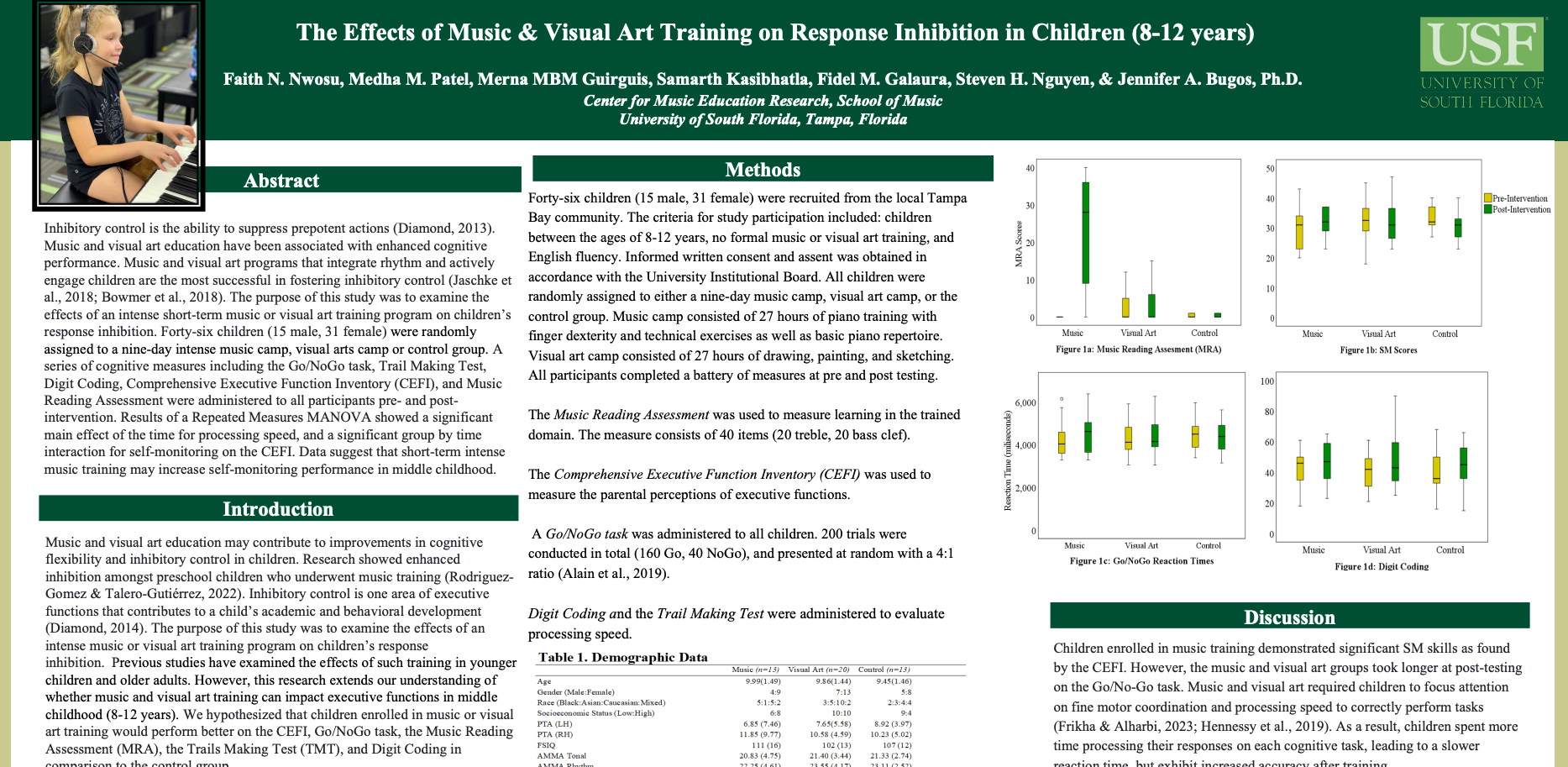
The Effects of Music and Visual Art Training on Response Inhibition in Children (8-12 years)
Merna Guirguis
Medha Patel
University of South Florida College of Arts and Sciences
Inhibitory control is the ability to suppress prepotent actions (Diamond, 2013).
Music and visual art education have been associated with enhanced cognitive
performance. Music and visual art programs that integrate rhythm and actively
engage children are the most successful in fostering inhibitory control (Jaschke
et al., 2018; Bowmer et al., 2018). The purpose of this study was to examine the
effects of an intense short-term music or visual art training program on
children’s response inhibition. Forty-six children (15 male, 31 female) were
randomly assigned to a nine-day intense music camp, visual arts camp or
control group. A series of cognitive measures including the Go/NoGo task, Trail
Making Test, Digit Coding, Comprehensive Executive Function Inventory
(CEFI), and Music Reading Assessment were administered to all participants
pre- and post-intervention. Results of a Repeated Measures MANOVA showed
a significant main effect of the time for processing speed, and a significant
group by time interaction for self-monitoring on the CEFI. Data suggest that
short-term intense music training may increase self-monitoring performance in
middle childhood.
Impact of STAT3 Inhibition on Tumour Progression and Immune Evasion in Non-Small Cell
Lung Cancer
Alejandra Santos, Anjali Mukamalla, Saranya Nallamothu, Sandy Henin
University of South Florida College of Public Health
Signal Transducer and Activator of Transcription 3 (STAT3) is a critical transcription factor that regulates cell growth, survival and immune responses. It is implicated in Non-Small Cell Lung Cancer (NSCLC), the most prevalent form of lung cancer categorized by aggressive tumour progression and high metastatic potential. NSCLC’s aggressiveness stems from the overactivation of STAT3, promoting cancer cell proliferation, survival, and invasion through mechanisms including genetic mutations, cytokine signalling and inflammatory pathways within the tumour microenvironment. This heightened STAT3 activity not only supports tumour growth but also suppresses anti-tumour immune responses and fosters an immunosuppressive environment. Currently, treatment for NSCLC patients involves cancer therapies that reduce tumour cell proliferation. This study investigates the impact of STAT3 inhibition in NSCLC that suppresses the anti-tumour immunity and epithelial-mesenchymal transition in the cancer cells. This article utilizes the PubMed database to retrieve a total of twenty articles regarding the effects of STAT3 on cell growth and metastasis, specific STAT3 inhibitors such as W2014-S, IL-37, MicroRNA-148a, RITA and WP1066, and investigating their effects on NSCLC. Inhibiting STAT3 reduces tumour cell proliferation while enhancing T-cell activation and reducing immunosuppressive factors within the tumour microenvironment. Some studies observed the role of STAT3 inhibitors with both in vitro and in vivo samples, highlighting the therapeutic potential. STAT3 clearly has a crucial role in aggressive pathogenesis seen in NSCLC due to increased immune evasion; thus, the inhibition would help reduce the tumour invasiveness, offering a promising therapeutic approach to mitigate NSCLC progression and enhancing the efficacy of existing treatments.
Targeting STAT3: An Approach to Reducing Neuroinflammation in Autism Spectrum Disorder
Sofia Profeta (siprofeta@usf.edu), Jillian Tulchinsky (jilliantulchinsky@usf.edu), Adelaide Lasater (alasater@usf.edu), Elaine Pan (elainepan@usf.edu)
University of South Florida College of Arts and Sciences
Autistic Spectrum Disorder (ASD) is a neurodevelopmental disorder that involves chronic neuroinflammation of the brain and is characterized by difficulties in learning, behavior and social interactions. Signal transducer and activator of transcription 3 (STAT3), a transcription factor involved in Th17 cell differentiation and activated by cytokines such as IL (interleukin)-6 and IL-17, plays a key role in regulating neuroinflammation, a hallmark of ASD. The aim of this literature review is to explore the role of STAT3 activation and its potential contribution to neuroinflammation in ASD. A systemic analysis of 42 peer-reviewed articles containing the keywords “STAT3” and “Autism” was analyzed from the PubMed database, with articles screened for relevance to topic. Current literature consistently demonstrates that STAT3 activation is influenced by factors, including elevated levels of pro-inflammatory cytokine, exposure to environmental stressors and maternal immune activation (MIA). Studies indicate that MIA elevates IL-6 levels, which subsequently activates the STAT3 pathway, promoting neuroinflammation in newborns later diagnosed with ASD. Moreover, experimental models reveal that inhibition of STAT3 signalling reduces pro-inflammatory cytokine production, highlighting its therapeutic potential. These findings suggest that STAT3 plays a pivotal role in mediating neuroinflammation associated with ASD. Further research should focus on establishing a direct causal link between STAT3 activation and the development of ASD, as this could open avenues for targeted therapeutic strategies aimed at mitigating neuroinflammation and improving clinical outcomes for individuals with ASD.
The Impact of Fentanyl and Xylazine on Respiratory Control Mechanisms
Joy Yang joyyang@usf.edu
University of South Florida College of Arts and Sciences
The opioid epidemic is one of the most severe public health crises in the United States today. Historically, there have been three waves of opioid-related mortalities. The third wave (2013 - present) is defined by synthetic opioids, primarily illegally manufactured fentanyl (IMF). It is supplemented by a polysubstance abuse crisis, in which non-opioid adulterants such as xylazine exacerbate opioid-induced respiratory depression (OIRD). The co-administration of IMF and xylazine, a veterinary sedative, severely impacts respiratory control mechanisms. This review synthesizes current literature to examine IMF and xylazine’s individual and synergistic effects on central nervous system (CNS) pathways regulating respiration. It also identifies critical gaps in understanding, and implications in further research. Findings suggest that fentanyl and xylazine synergize in targeting CNS respiratory pathways, increasing the risk of OIRD and mortality. Understanding these mechanisms is critical for mitigating the continuation of opioid-related mortality.
Potential Causes for the Early Onset of Colorectal Cancer (EOCRC)
Manasa Jaishankar (manasajaishankar@usf.edu), Irfan Sharif (irfansharif@usf.edu), Stuti Dibbur (stutid@usf.edu), Lyndsey Hamsher (lyndseyhamsher@usf.edu)
University of South Florida
Colorectal cancer (CRC) arises in the digestive system, specifically the colon and rectum. Trends in CRC have become prevalent in individuals under the age of 50, this early form is referred to as Early-onset Colorectal cancer (EOCRC). As the third leading variant of cancer, associated risks include excessive exposure to antibiotics, drinking and smoking, western diets, and sedentary habits, which result in alterations to the gut microbiota; these alterations lead to inflammation and subsequent development of EOCRC. Genetic syndromes including Lynch syndrome, familial adenomatous polyposis (FAP), and MUTYH-associated polyposis (MAP), are also associated with increased EOCRC risk. These disorders are associated with genetic mutations that disrupt normal DNA repair, which significantly raises the risk for development of EOCRC. To reduce the healthcare impacts of EOCRC, early screening advocacy has focused its efforts on providing individuals with genetic risk factors with easier accessibility for screening. For individuals diagnosed with EOCRC, traditional methods of surgery, chemotherapy, immunotherapy, and radiation are common; however, these conventional methods often have lasting side effects and do not prevent late-onset colorectal cancer (LOCRC). Targeted therapies have not evolved to identify and block cancer-promoting signaling systems for EOCRC. Regardless, technological developments have increased the future prospects of treatment for EOCRC; clinical trials building upon nanotechnology and advancements in DNA and RNA identification are instrumental in creating effective targeted therapies.

