Tsugi: Eradicating Mental Health Stigma Among Amputees Through Digital Mentorship
Ria Arora arorar@usf.edu, Naman Sehgal namanseghal@usf.edu, Sudeepa Pasupuleeti sudeepapasupuleeti@usf.edu.
University of South Florida College of Engineering
This research examines whether a digital platform, Tsugi, employing AI-driven peer mentorship, can reduce mental health stigma and improve access to mental health support, thereby decreasing rates of depression and anxiety among amputees. Amputees face disproportionately high rates of mental health challenges, with 35% experiencing depression and 60% suffering from anxiety within the first six months after limb loss (Jo et al., 2021). Stigma surrounding both limb loss and mental health exacerbates these challenges, discouraging individuals from seeking help. Existing peer-support programs, such as AMPOWER and the Amputee Coalition app, struggle with extreme volunteer dependency and limited personalization, reducing their effectiveness (Amputee Coalition, 2024; Clean with Ross, 2024). This study explores the potential of Tsugi, an AI-driven digital mentorship platform, to address these limitations by fostering a stigma-free support environment through peer mentorship. Preliminary findings suggest that structured digital mentorship significantly improves self-perception, reduces social anxiety, and enhances help-seeking behaviors within the prosthetic community (Gainesville Prosthetics, 2023). Additionally, 75% of amputees report that peer support positively impacts their outlook on life, while 78% find the shared information beneficial (Lee et al., 2024). By leveraging AI-integrated digital ecosystems, like Tsugi, this research aims to dismantle deeply ingrained stigmas and establish scalable, technology-driven psychological support models for amputees worldwide. Addressing both emotional and practical challenges, Tsugi fosters a more inclusive and empowering recovery experience for amputees, ensuring long-term engagement with mental health care.
The Ongoing Evolution of ACLS
Daniela Simon-Fajardo (danielasimon@usf.edu), Aly Carter (alysoncarter@usf.edu), Esha Haque (ehaque@usf.edu), Zoeya Faisal (zoeyafaisal@gmail.com), Stuti Dibbur (stutid@usf.edu)
University of South Florida College of arts and sciences
Background: The utilization of Advanced Cardiac Life Support (ACLS) within hospitals saves thousands of lives annually due to continuous practice that is evolving the advancement of medicine. However, ongoing research has highlighted limitations of current ACLS methods. ACLS and its training process is evolving continuously to optimize the settings in a medical environment including complications during CPR, medicine administration,prioritizing post-resuscitation care, and timely intervening when factors such as pre-existing conditions arise. Methods: A literature review of 80 peer-reviewed papers examined ACLS instruction retention, evolving ACLS guidelines, and modern ACLS methods such as extracorporeal cardiopulmonary resuscitation and cardiac ultrasound during resuscitation. Results: This review identified key trends in the evolution of ACLS, including improvements in training retention, adaptations of ACLS guidelines, and the integration of newer resuscitation methods. Studies show that while ACLS-trained personnel demonstrate better short-term outcomes, up to 35%-45%, overall post-resuscitation discharge rates remain relatively low, reflecting the limitations of current protocols. Additionally, training advancements like simulations have shown to improve skill retention and provider performance by 20%-40%. Conclusion: Updates to ACLS guidelines have focused on refining administration, optimizing CPR techniques, and prioritizing post-resuscitation care to improve long-term outcomes. A major shift in recent years has been the incorporation of artificial intelligence into ACLS training, offering promising opportunities to enhance patient outcomes and strategies. While the long-term impact on knowledge recollection remains inconclusive, these findings emphasize the importance of research in AI technology, simulation courses, and
The Role of STAT3 in Uveitis
Avery Moriyasu & armoriyasu@gmail.com, Mimi Nguyen & Mimipham120605@gmail.com, Teerth Pansuria
University of South Florida College of Arts and Sciences
Uveitis is an inflammatory eye condition that has been linked to possible causes of infection, injury or autoimmune disease. STAT3 is a protein that is responsible for sending signals to a cell’s nucleus. When activated, it turns on specific transcription genes which control cellular functions such as growth and self-destruction. Prior research has investigated the effects of both STAT3 inhibition/deletion and stimulation and its effects on rats with autoimmune uveitis. However, the role of STAT3 on uveitis in humans remains largely unexplored. This literature review discusses how STAT3 works and its correlation to managing uveitis. A systematic literature review was conducted on 12 peer-reviewed articles, which consisted of studies demonstrating Th-17’s role in causing uveitis and quantitative analysis of STAT3’s effects on Th-17 cells and therefore uveitis. The literature suggests that Th-17 cells are one of the causes in the pathogenesis of autoimmune disease, in particular uveitis. Studies consistently report that STAT3 is necessary for the differentiation of Th-17 cells, and therefore when STAT3 is inhibited, Th-17 levels decrease and so too do experimental autoimmune uveitis (EAU) cells. While test trials thus far have only been conducted on mice, their cell pathology for the purposes of uveitis is similar to our human pathology. These studies suggest that by inhibiting/deleting STAT3, fewer Th-17 cells will be produced, and therefore the severity of uveitis will be decreased. Future studies could focus on the inhibition/stimulation of other cells that play a role in Th-17 cell development.
The Integration of AI in Anesthesiology and Its Ethical Implications
Praise Ofakunrin: ofakunrinp@usf.edu, Mahek Mody: mahekmody@usf.edu, Natalia Poland: nataliapoland@usf.edu, Smruthi Ram: rams@usf.edu, Azlin Edwards: azlin@usf.edu, Aishwarya Aggarwal: aggarwal1@usf.edu
University of South Florida College of Public Health
Artificial Intelligence (AI) is increasingly prevalent in anesthesiology due to its advancements in quality and safety. Systems like anesthesia information management systems (AIMS) assist with patient care, automated recordkeeping, and drug calculations. This review explores the challenges and impacts of AI in anesthesia by examining how it can be ethically and effectively integrated to enhance clinical decision-making while addressing concerns about bias, data privacy, and security. A comprehensive review was conducted, screening 96 peer-reviewed articles from PubMed using terms ‘artificial intelligence’, ‘anesthesia’, and ‘ethics’. Exclusions were made for studies focusing on AI in other medical specialties, clinical trials, and animal studies. 33 articles were selected and analyzed based on their focus on AI’s clinical accuracy, ethics, and effectiveness in anesthesiology. Research indicates that AI in anesthesia improves clinical decision-making, outcome prediction, and data analysis. Deep neural networks achieve a 92.9% accuracy in anesthesia depth assessment and 97% accuracy in anatomical landmark identification. AI-guided ultrasound imaging analysis enhances peripheral nerve detection and block precision, supporting risk stratification and perioperative monitoring. Anesthesiology is continually being improved by AI, a useful tool for patient safety and monitoring, operating room management, and procedural efficiency. However, ethical challenges related to data privacy, potential bias, and accountability must be addressed. To ensure AI systems are rigorously tested and continuously monitored across different stages, a total product framework can be implemented to mitigate ethical concerns. Establishing clear ethical guidelines and fostering collaboration among researchers, clinicians, and policymakers is key to responsible AI integration.
Evaluating the Use of Virtual Reality in Medical School Neuroanatomy Curriculum: A Nonrandomized Pre-Post Intervention Study with Medical Students
Henry Blagden hblagden@usf.edu, Antonious Rizkalla Antoniousrizkalla@usf.edu
University of South Florida College of Arts and Sciences
The spatial relationship of neuroanatomy is very complex and thus renders this topic hard to understand for the students. Virtual reality offers a realistic and interactive mode of learning which could be used to enhance medical student education. This article discusses the efficacy and feasibility of VR in teaching first year medical neuroanatomy courses. A non-random pre-post intervention study was conducted with 12 medical students. Participants underwent a pretest of neuroanatomy knowledge, then an interactive lesson on VR-based high-resolution volumetric brain renderings with a Meta Quest 2 headset, and lastly a posttest. Learning outcome, usability, and students' experience were measured. The posttest scores showed a significant improvement (+14.58% on average), indicating that VR had a positive effect on neuroanatomical retention of knowledge. Subjective student feedback was overall positive, but usability ratings were below standards on the System Usability Scale, which indicated some technical and comfort issues. Exploratory analyses suggested that the use of VR may have benefited those with lower spatial ability, enabling them to achieve performance levels similar to those of students with higher spatial ability. Our findings show promise in applying VR to improve education in neuroanatomy with its visual and interactivity enhancement; yet, its efficiency needs to overcome some technical issues and usability and logistical implementation issues for medical curricula. Therefore, future research through more extensive and randomized studies would be helpful in verifying and optimizing these results with more integration of VR.
Comparative Antifungal Efficacy of Herbal and Conventional Treatments Against Malassezia
Chinaza Munonye, cmunonye@usf.edu
University of South Florida College of Public Health
Malassezia, a genus of commensal fungi, is implicated in various dermatological conditions, including dandruff and eczema, which are often challenging to treat. Conventional antifungals are widely used, but herbal alternatives are gaining attention for their potential efficacy. This study aimed to compare the effectiveness of conventional and herbal antifungals in inhibiting fungal growth, using Saccharomyces cerevisiae as a model organism. Four antifungals—ketoconazole 1% shampoo, zinc pyrithione 1% shampoo, cinnamon oil, and clove bud oil—were diluted to 30% concentrations and tested using the Kirby-Bauer assay. Statistical comparisons were conducted between conventional and herbal treatments, followed by a final comparison between the most effective agents from each category. All antifungals demonstrated inhibitory effects at 30% concentration. Cinnamon oil was the most effective among the herbal treatments, while zinc pyrithione outperformed ketoconazole in the conventional category. Ultimately, cinnamon oil exhibited the strongest antifungal activity overall. These findings suggest that herbal essential oils, particularly cinnamon oil, may serve as viable alternatives or adjuncts to conventional treatments for Malassezia-associated conditions. Future research should explore optimized formulations, mechanisms of action, and clinical applications to enhance therapeutic outcomes.
Understanding Dermatological Drug Reactions in Skin of Color: Awareness, Presentation, and Clinical Implications
Chinaza Munonye, cmunonye@usf.edu
University of South Florida College of Public Health
Patients with skin of color (SOC) exhibit distinct dermatological drug reaction patterns, yet research and clinical awareness of these variations remain insufficient. This ethnographic study investigates the differential presentation of adverse drug reactions (ADRs) in SOC and assesses public awareness of these disparities. A mixed-methods approach was employed, including a survey (n=40) and structured interviews with a board-certified dermatologist and a clinical pharmacist. Survey data revealed that while 75% of respondents recognized racial disparities in dermatology, 80% were unfamiliar with SOC dermatology as a distinct subspecialty. Among participants, 9.5% reported experiencing dermatological ADRs, most commonly urticaria, rashes, and hyperpigmentation, attributed to NSAIDs, antibiotics, vaccines, and chemotherapy agents. Clinician interviews confirmed that SOC patients exhibit a higher prevalence of hyperpigmentation and dusky or exanthematous eruptions, contrasting with the urticarial and pustular reactions more frequently observed in lighter skin tones. These findings highlight the urgent need for targeted clinical education, improved dermatopharmacological research, and the development of SOC-inclusive treatment protocols to enhance diagnostic accuracy and therapeutic outcomes in diverse patient populations.
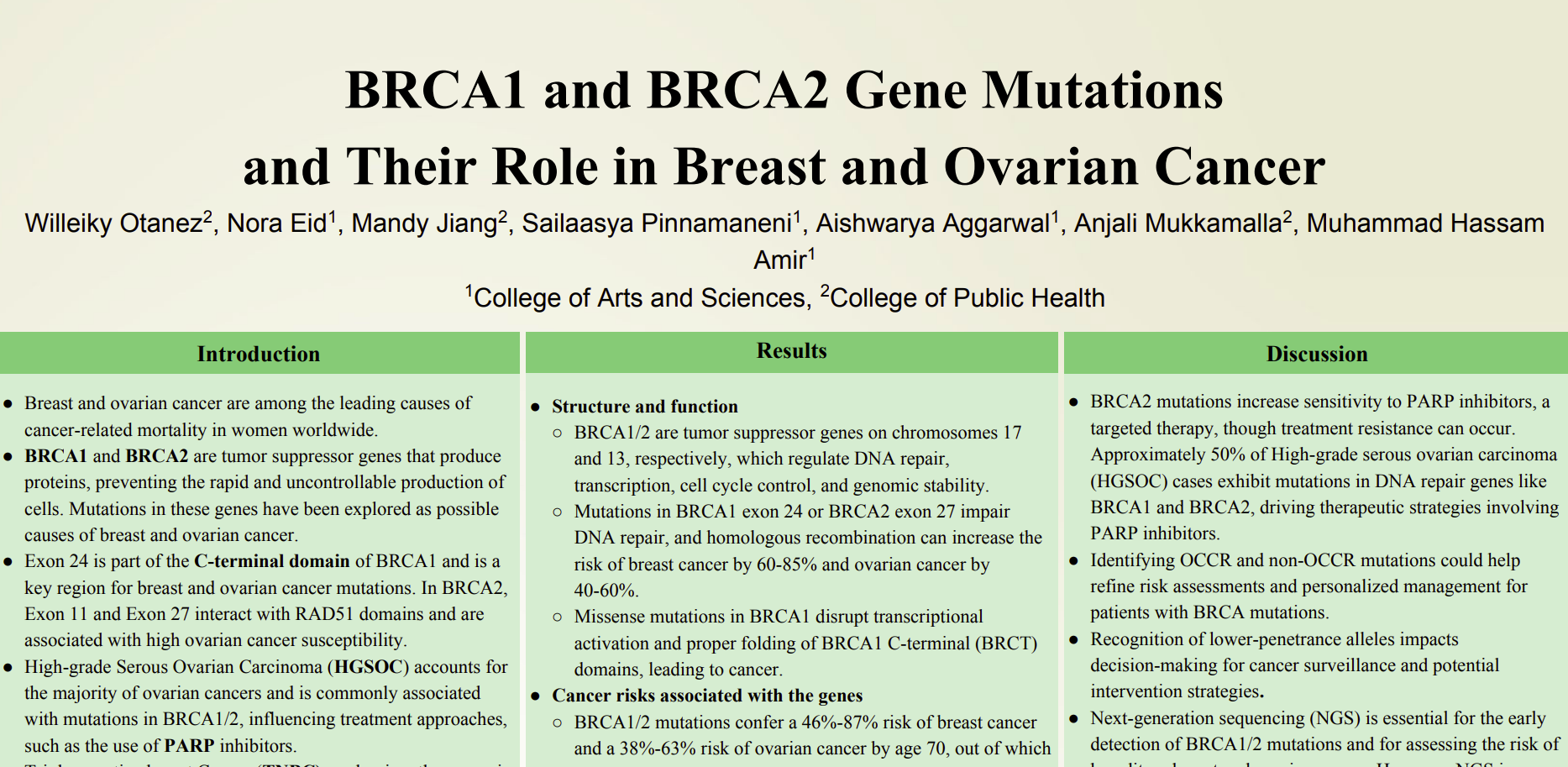
Role of PCSK9 Inhibitors in Genetic Management of High Cholesterol
Megan Reddy meganreddy@usf.edu, Ammar Anjum ammar8@usf.edu, Brisly Fideles Frias Rodrigues Cunha brislydacunha@usf.edu, Madison Knight madisonknight@usf.edu, Ian Sierra-Gonzalez iansierragonzalez@usf.edu, Pietra Soares De Oliveira De Andrade pietras13@usf.edu, Ryan Chowdhury chowdhury60@usf.edu
University of South Florida Undergraduate Research Society
Hypercholesterolemia, specifically familial hypercholesterolemia, is a genetic condition that occurs due to mutations in Low Density Lipid-Receptor (LDL) genes, leading to high levels of LDL-C. High levels of LDL-C are associated with Atherosclerotic cardiovascular disease (ASCVD), coronary artery disease (CAD), and stroke. Annually, approximately 4.4 million deaths occur to cholesterol related diseases, emphasizing the need to develop therapies that manage high cholesterol. Proprotein convertase subtilisin/kexin type 9 (PCSK9) is protein that is vital to regulating LDL receptors and maintaining overall lipid homeostasis by binding to LDL receptors on the surface of hepatocytes. Increased PCSK9 activity has been shown to lead to higher LDL-C levels, which increases the risk of obtaining cholesterol related diseases. PCSK9 inhibitors prevent the binding of PCSK9 to LDL receptors, thus also preventing the clearance of LDL-C into the body. Patients with familial hypercholesterolemia often exhibit resistance to statins due to mutations affecting LDL receptor functionality. Monoclonal antibodies, RNA interference, and gene-editing techniques such as CRISPR-Cas9 can all be used to inhibit the PCSK9 gene. These therapies allow for the effective control of LDL-C, overcoming the limitations of traditional treatments, and improving overall health outcomes. This project will provide a comprehensive review of the evolving applications of PCSK9 inhibitors in genetic hypercholesterolemia management, emphasizing the need for further research to be conducted on this area.
Adropin and its Future Role in Controlling Obesity
Abhinav Nadimpalli, Shrey Dhamal, Danton Nguyen, Levi Day, Jun Jie Zheng
University of South Florida College of Arts and Sciences
The regulatory peptide Adropin has recently gained significant attention in relation to obesity, diabetes, and cardiovascular health. Although research has suggested its potential roles in improving insulin sensitivity, regulating lipid homeostasis, and reducing inflammation, the specific interactions with these pathways remain unclear, and its clinical applicability has yet to be explored. Furthermore, there are still several unknown aspects concerning the role of Adropin in its connection to various metabolic pathways across different population groups and diseases.
This review provides a comprehensive analysis of the current literature on Adropin in chronic metabolic disorders, with a particular focus on its effects on obesity management. A systematic search of databases for research from the past decade was conducted to identify studies examining adropin’s implications in obesity and chronic metabolic processes. The findings from selected studies were analyzed to identify trends, research gaps, and future directions.
Results indicate that low circulating levels of Adropin are inversely correlated with obesity, insulin resistance, and arterial rigidity. Administration of Adropin has been shown to improve glucose tolerance and lipid profiles in animal models, highlighting its potential as a therapeutic agent. However, the variation in Adropin levels with respect to age, sex, and disease conditions underscores the need for standardized measurement protocols and further clinical investigations.
These findings offer deeper insights into the role of Adropin in metabolism and support its potential as both a biomarker and a therapeutic target. Future research should focus on better understanding dose-response relationships and the long-term effects of Adropin modulation in humans.
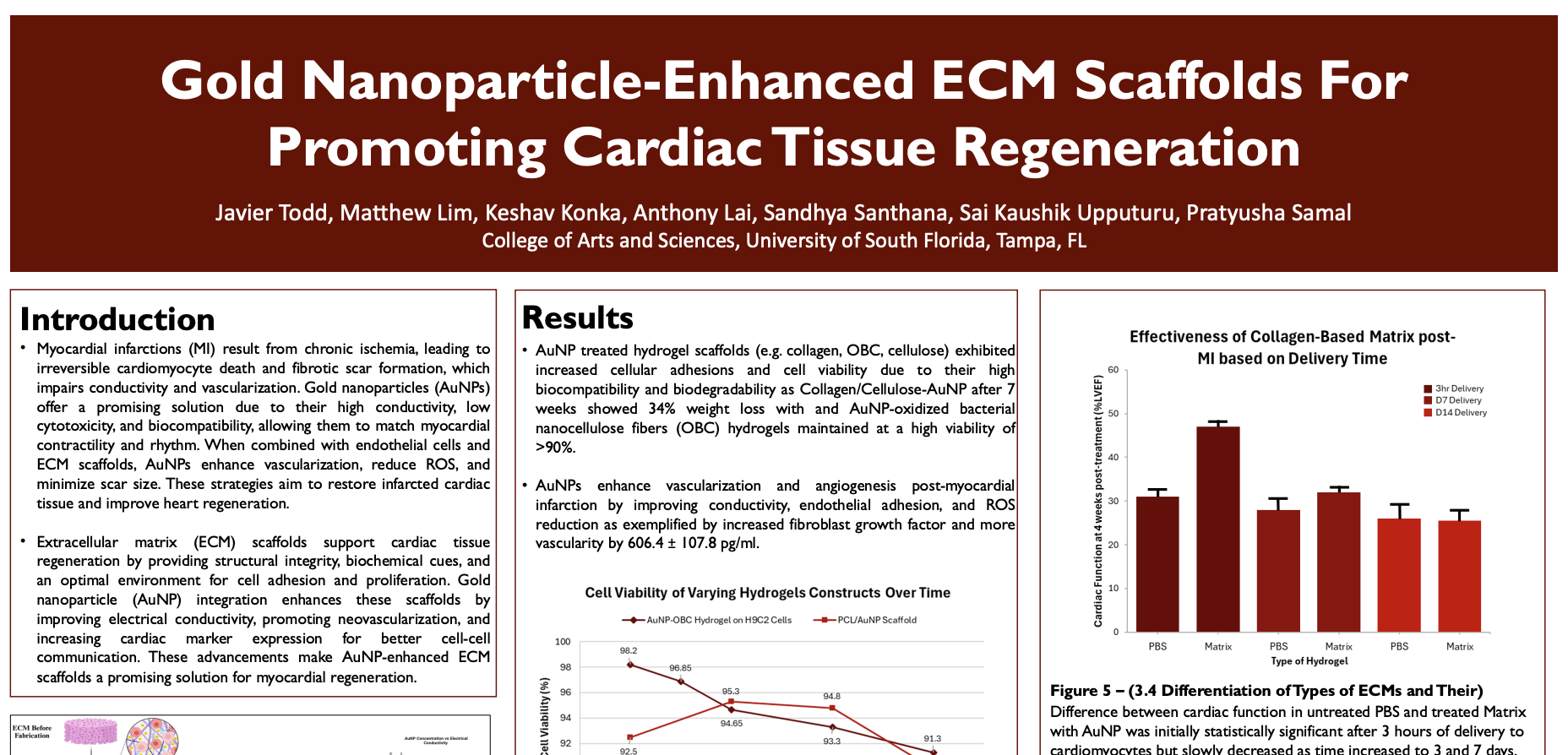
Gold Nanoparticle-Enhanced ECM Scaffolds for Promoting Cardiac Tissue Regeneration
Javier Todd, Matthew Lim, Keshav Konka Anjan, Anthony Lai, Sandhya Santhana, Sai Kaushik Upputuru, Pratyusha Samal
University of South Florida, College of Arts and Sciences
Cardiovascular diseases, including myocardial infarctions, are among the leading causes of mortality around the world, posing significant challenges for healthcare systems. Emerging technologies such as gold nanoparticles (AuNPs), through interactions with extracellular matrix (ECM) scaffolds, hold promise for advancing cardiac tissue regeneration and repair. The purpose of this review is to systematically compile the data on the role of gold nanoparticles in enhancing cardiac tissue regeneration. Specifically focusing on their efficacy in improving vascularization, electrical conductivity, and cardiac tissue function within extracellular matrix scaffolds. This systematic review followed the PRISMA protocol, identifying 103 relevant articles from an initial pool of studies. AuNP-enhanced scaffolds, both ECM-based and synthetic have shown significant potential for cardiomyocyte proliferation through electrical conductivity, mechanical properties, and therapeutic efficacy. Through spectroscopy and microscopy imaging, notable reduced infarcted cardiac regions of tissue were observed in murine models. AuNP-collagen composites showed enhanced biodegradability, dense revascularization, and myocardial contractility. Functionalized AuNPs, like PEG-coated variants, improved cardiac targeting and retention. There are limited studies and data in clinical studies, as the study focuses on understanding myocardial infarction in humans. Rat models also do not directly translate to human processes, so larger animal model studies are needed to mimic human anatomy and physiology. In conclusion, AuNPs show a promising potential in enhancing cardiac tissue regeneration by improving cardiomyocyte proliferation, vascularization, and improved conductivity of scaffolds. However, further clinical research in larger animal models is critical to understanding their applicability and translation into humans completely.

